

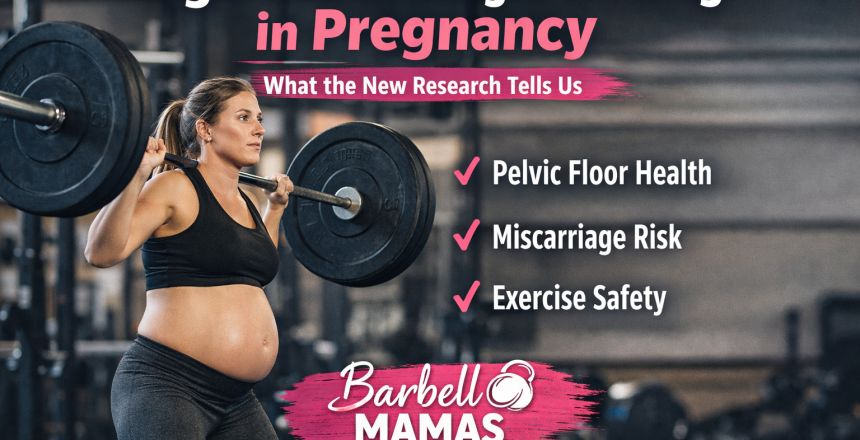
Whether you consider yourself recreationally active or a competitive athlete, pregnancy and postpartum bring up a lot of questions — especially around exercise, pelvic health, and safety.
At Barbell Mamas, our goal has always been to talk openly about the realities of being an active woman navigating fertility, pregnancy, postpartum, and beyond. That means addressing fear-based messaging, knowledge gaps, and the very real physical and emotional experiences that come with motherhood.
In today’s post, I want to walk you through:
The past year has been a big one professionally. Several research projects I’ve been working on for years are finally being published, and 2026 is shaping up to be a turning point where much of my postdoctoral work is becoming publicly available.
That matters because it allows us to move beyond opinion and fear — and toward data-informed conversations about exercise during pregnancy, miscarriage recovery, and long-term pelvic health.
My newly published paper in Medicine & Science in Sports & Exercise (the journal of the American College of Sports Medicine) is titled:
“High-Load Resistance Training in the First Trimester: A Retrospective Survey — Implications for Exercise Professionals and Obstetrical Providers.”
This study represents the first research of its kind to examine high-intensity strength training in the first trimester.
Participants were:
We examined:
One of the biggest gaps in pregnancy research is pre-conception pelvic floor health.
In athletic populations, 30–50% of female athletes — including those who have never been pregnant — already experience pelvic floor dysfunction, such as stress urinary incontinence.
Yet most women don’t learn about the pelvic floor until they’re already pregnant.
This raises an important question:
If many active women enter pregnancy with existing pelvic floor symptoms, how does that affect pelvic floor risk during pregnancy?
Here’s what surprised us:
Even more interesting:
In short:
👉 Continuing high-load resistance training in the first trimester did not increase pelvic floor dysfunction in this cohort.
Miscarriage Rates and Exercise: What the Data Showed
Miscarriage rate in this sample was approximately 23%, which is consistent with general population rates when accounting for early pregnancy loss and elective termination.
Importantly:
A Critical Gap: Return-to-Exercise Guidance After Miscarriage
One of the most concerning findings from the study was not about lifting — it was about lack of guidance.
Only a small percentage of participants reported receiving any advice on returning to exercise after miscarriage.
That matters.
Recovery from miscarriage can involve:
Yet structured return-to-exercise guidance is almost nonexistent.
Why I Started a New Study on Exercise After Miscarriage
This research is deeply personal.
I’ve experienced two pregnancy losses myself — one early, one later — and navigating return to exercise afterward was physically and emotionally challenging, even as a clinician and researcher.
That experience led to a new study, now approved by ethics, examining:
Who Can Participate?
You may be eligible if you:
This study exists because movement is often a critical coping tool — and we need better information to support people safely and compassionately.
Why Perimenopause Research Matters for Postpartum Women
The final topic I want to highlight is a large new systematic review and meta-analysis on perimenopause and musculoskeletal pain.
Why include this here?
Because more women are:
Key findings:
For active women, this means:
Understanding hormonal transitions helps us:
The Big Picture
Exercise is not the villain.
Fear-based messaging helps no one — especially active women navigating pregnancy, loss, postpartum recovery, and hormonal transitions.
What we need instead is:
And that’s exactly what this body of research is working toward.

Christina Prevett is a pelvic floor physiotherapist who has a passion for helping women with different life transitions, including postpartum care and menopause.