

Years ago, I was a national-level weightlifter heading into pregnancy—and I wanted to keep training. The internet being the internet, I got hit with the classic fear-messaging: “Don’t lift or your baby will be harmed,” “Your organs will fall out,” and a whole lot of shame wrapped in “concern.”
That experience helped shape my career: I now research how high-intensity movement intersects with pelvic floor function—especially in the pre- and postnatal period.
And this topic matters even more in physically demanding occupations like the military, where load carriage, fatigue, impact, and imperfect recovery conditions can all stack the deck.
Here’s the big picture: pelvic floor symptoms are common, and for many people they become a reason to modify or stop exercise—which is a problem, because we don’t exactly have a “population too active” crisis.
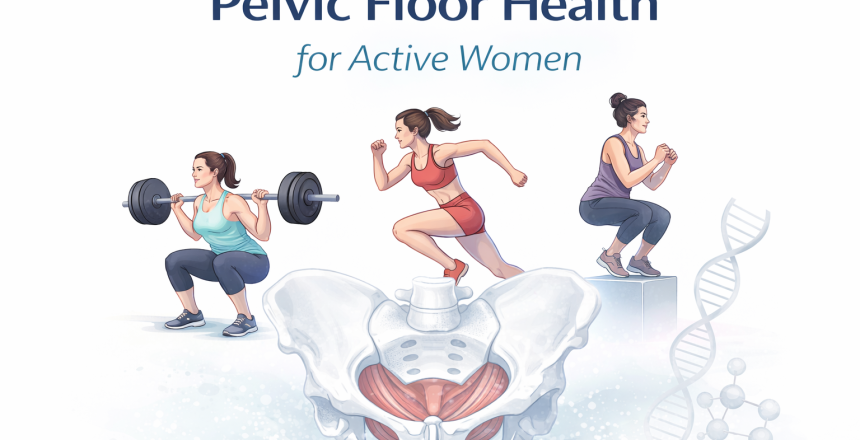
Think of the pelvic floor as a group of muscles at the base of your pelvis that supports the bladder, bowel, and (in females) the uterus—and works as part of your pressure and force transfer system.
It’s involved in:
The most important reframe: the pelvic floor behaves like other muscles. It needs to contract, relax, and coordinate—at the right time and to the right intensity for the task.
High-demand activities repeatedly challenge the pelvic floor with some combination of:
In sports and performance settings, pelvic floor symptoms (especially leaking) are often reported at high rates—frequently around ~50% in strength/power/impact athletes depending on the population and how symptoms are defined.
Then we layer on female lifespan transitions that can change tissue characteristics and symptom risk:
Symptoms don’t mean you’re broken. They often mean your system has hit a capacity/coordination threshold.
1) Urinary incontinence (leaking)
The most common type in active women is stress urinary incontinence—leaking with pressure increases like coughing, sneezing, laughing, lifting, jumping, or sprinting.
A subset is athletic incontinence: daily life is fine, but symptoms appear only at higher thresholds (e.g., mile 5 of a ruck, double-unders, heavy deadlifts).
Key point: athletic incontinence is often the “early warning sign.” Ignoring it can shift the threshold downward over time (from only heavy lifts → to coughing/sneezing).
2) Pelvic organ prolapse (heaviness or bulging)
Prolapse is about vaginal wall movement and support. Vaginal walls are not rigid tubes—they move, and that movement varies with time of day, fatigue, hormones, constipation, and training load.
What matters clinically is symptoms:
3) Pelvic pain (complex and multifactorial)
Pelvic pain deserves nuance. It can be influenced by:
If you take away one thing here: pelvic pain is rarely “just one tight muscle” or “just weak.” It’s a whole-person puzzle—and treatable.
What helps: Pelvic floor training (but not just “do Kegels”)
Pelvic floor muscle training is supported by strong evidence as a first-line intervention for many pelvic floor conditions.
But the modern upgrade is this:
For many active people, the missing pieces are:
A simple way I explain it clinically is identifying the dominant driver:
(Those are my very scientific category names 😅)
Bracing matters more than most people realize
If you lift, you brace. The goal isn’t to eliminate pressure—it’s to distribute it well.
A cue I like:
Inhale, then brace like someone is about to poke you in the belly / your kid is about to cannonball onto you.
Ribs stacked over pelvis. “Hug around” your trunk.
Common performance mistake: bearing down (pressure dumps downward). In some women, that can show up as leaking. In many men, it can show up as hemorrhoids/strain patterns.
And for the record: there has been a big shift away from demonizing bracing/Valsalva in all cases. The nuance is context, symptoms, and technique—not blanket fear.
If you’re a coach, trainer, clinician, or the “mom friend who everyone texts,” here’s a useful starting list.
Consider referral if someone has:
Helpful screening questions:
Training through pregnancy: the shift away from fear
We’ve come a long way from “don’t lift more than 20 pounds” recommendations that were often based less on evidence of harm and more on lack of research in pregnant populations.
Evidence on resistance training in pregnancy has expanded substantially, including studies examining higher-intensity lifting and acute maternal/fetal responses.
And we have data specifically describing outcomes in people who continued heavy resistance training in pregnancy (including those lifting ≥80% of their pre-pregnancy 1RM), which helps push back on blanket restrictions.
The more useful framework:
There’s no universal “safe vs unsafe exercise list.”
Instead, decisions should reflect:
Practical modifications often include:
Postpartum: return to exercise is individualized (and earlier movement can help)
Canada released stand-alone postpartum movement guidelines—an international first—and they’re a big deal for shifting the narrative away from “do nothing for 6 weeks.”
A few headline ideas reflected in these postpartum recommendations:
My clinical reframe:
Postpartum rehab shouldn’t be “all-or-nothing.” Your pelvic floor and whole system are rebuilding capacity.
We use symptoms as information:
That’s rehab.
The underrated piece: relaxation and down-training
If someone is living in “tight and braced all day,” telling them to do more Kegels can backfire.
Signs you might be dealing with an overactive/tense system:
Simple starter positions that can help restore pelvic floor excursion:
Pair with slow breathing and a focus on letting the pelvic floor soften and drop (not pushing—just releasing).
The bottom line
Pelvic floor symptoms are common in active women—and in tactical populations where load, fatigue, and recovery constraints collide.
But common doesn’t mean “normal forever,” and it definitely doesn’t mean you have to stop training.
With the right lens—capacity, coordination, relaxation, and whole-body strength—most people can keep doing what they love with fewer symptoms and more confidence.

Christina Prevett is a pelvic floor physiotherapist who has a passion for helping women with different life transitions, including postpartum care and menopause.